Hideo Morii Gives Modern-Day Premières of Pre-Second World War Japanese Guitar Repertoire
Interview with Thérèse Wassily Saba
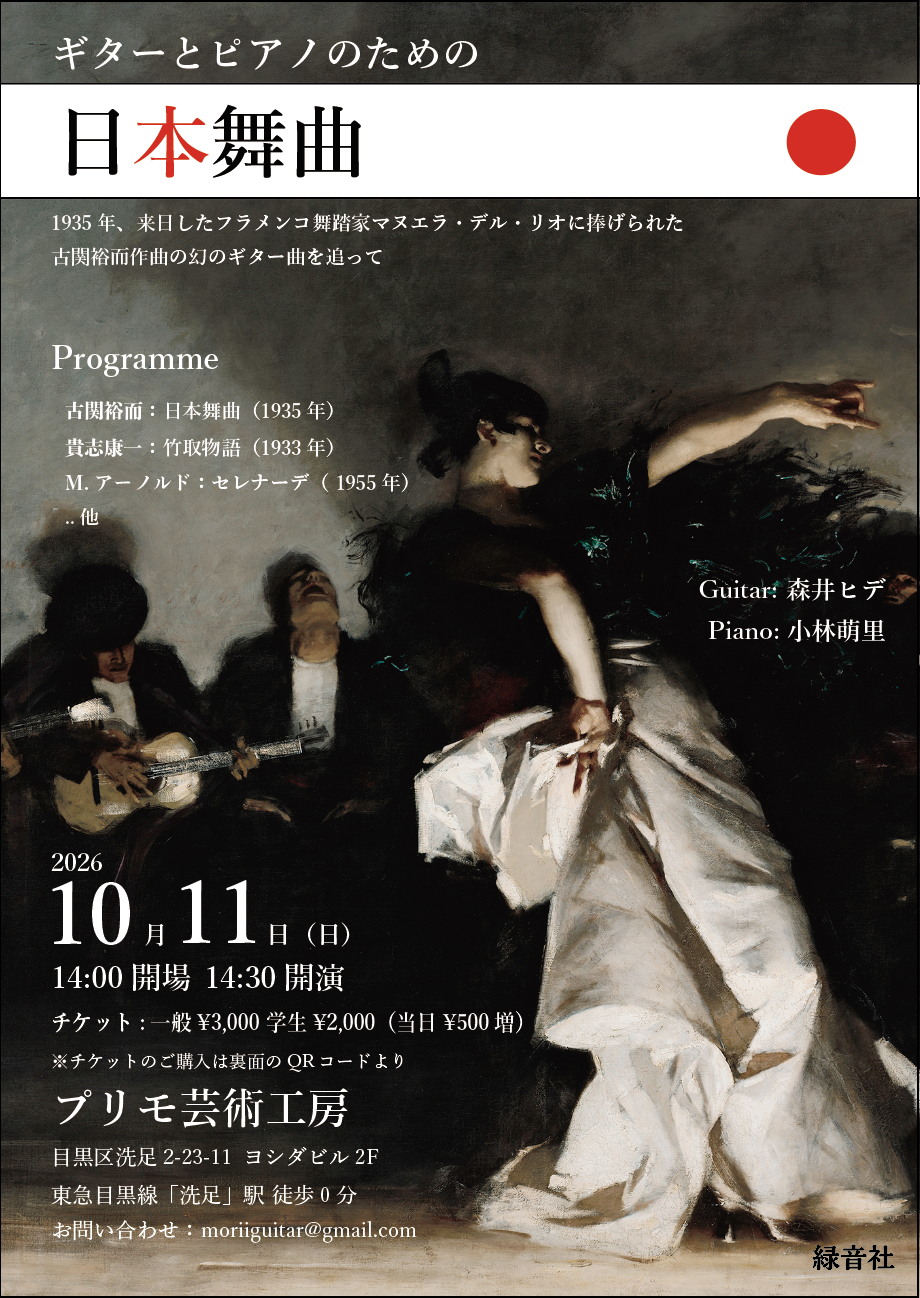
The Japanese guitarist Hideo Morii, who has been exploring the pre-Second World War repertoire for the classical guitar written by Japanese composers for some time, will be performing some of these works at his concert in Tokyo on Sunday 11 October 2026.
Hideo Morii studied classical guitar at Trinity College of Music, London and obtained a BMus and FTCL diploma there. Coincidentally, he studied with experts in South American music both in the UK and Japan, Graham Devine and Gentaro Takada, naturally became committed in South American music. He has had masterclasses with Yamandú Costa, Celso Machado, Juan Falú and Carlos Moscardini and has played with Javier Contreras and Mirta Alvarez. He has given concerts in England, Germany, Brazil, Argentina and Japan.
I spoke to him about his forthcoming concert and the Japanese music he has discovered.
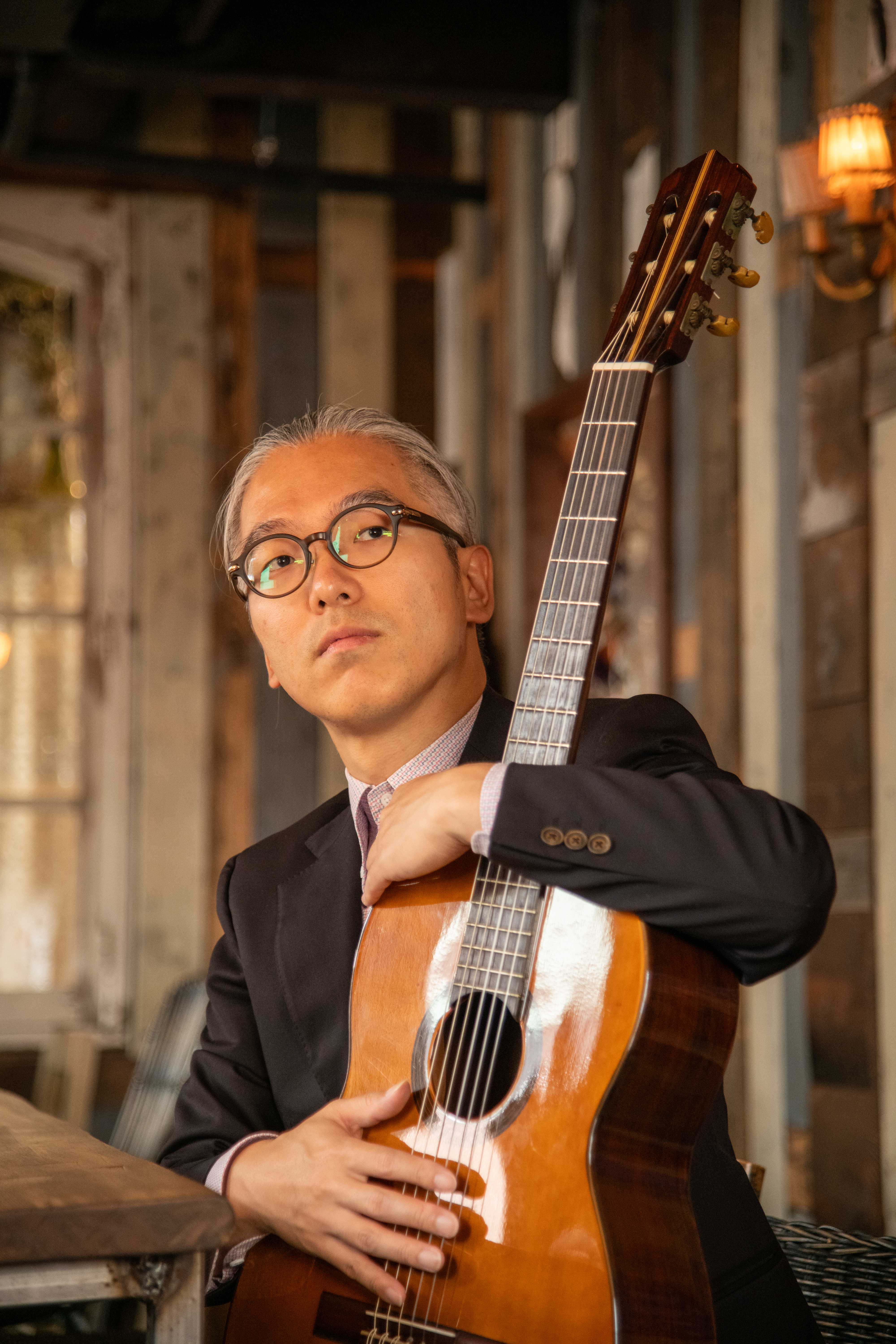
Hideo: On 11 October 2026, I am going to play the modern première of Danza Japonesa (1935) by the Japanese song and film composer Yuji Koseki. This piece was written for guitar and piano in 1935 but has been long forgotten since then – no one seemed to play it after the Second World War.
Yuji Koseki became famous as a songwriter but, at the beginning of his career, he had wanted to be a classical composer. He composed Danza Japonesa during the time when that transition in his composing career was happening – where he was moving from composing classical works to popular songs.
Although he had planned to study in the UK, unfortunately, this plan was never realised. If he had, he might have become a classical composer. For this reason, I will play the Serenade for guitar and strings, Op. 50 (1955) by Malcolm Arnold at the concert to invite the audience to imagine what might have been. I will be playing a piano reduction, with the pianist Moeri Kobayashi.
We will also play Taketori monogatari (The Tale of the Bamboo Cutter, 1933) by another Japanese composer from that period, Koichi Kishi. It is originally written for violin and piano and I have transcribed it. Koichi Kishi was born in 1909, in the same year as Yuji Koseki. Koseki actually composed a piece using the same title, Taketori monogatari and sent it to the English publisher, Chester Music. He had hoped that would give him a chance for when he arrived in the UK, but sadly he was not able to go there and the sheet music has since been lost. Curiously, these two composers who were born in the same year composed works under the same title: Koichi Kishi went on to study abroad as a violinist at the Geneva Conservatory and the Berlin School of Music, he studied composition with Paul Hindemith and conducting with Wilhelm Furtwängler; in contrast, Yuji Koseki remained in Japan and achieved great success in composing popular music. I selected this piece, Taketori monogatari, to convey this remarkable coincidence and the huge contrast in their life stories. Yuji Koseki died at the age of 80, but Koichi Kishi in 1937 at the age of 28!
The concert will be on Sunday 11 October 2026 at Primo Geijyutsu-Kobo, at 2pm. Primo Geijyutsu-Kobo, 2-23-11 Yoshida Bldg, Senzoku, Meguroku. Nearest station, Senzoku on Tokyu Meguro line. For further details, contact: moriiguitar@gmail.com
Hideo Morii has a strong interest in South American music and has a guitar duo with Haruka Shimizu with the name Rio del Bosque for their guitar duo. In our interview, which continues below, Hideo Morii talk about how their performance at the Cosquín Folk Festival inspired him to begin researching the pre-Second World War repertoire for classical guitar.
Hideo: Although the relationship seems a bit far, the motivation came from when I went to Argentina to play in the Cosquín Festival, where Haruka and I played Argentinian folkloric music. At a hotel in Buenos Aires, a 20-year-old local asked me to play the guitar, so I played Argentinian music and he loved it. Then he asked me if I could you play some folkloric music from my district. He didn’t say a Japanese song, he just asked for some folkloric music from my area. Then, I realised that I really didn’t know anything like a district song because I have devoted myself classical music. Of course, I knew some Japanese traditional songs like Sakura (Cherry Blossom) and also Takemitsu’s music, but it sounded a little bit remote for me to call them my folkloric music.
When I got back from Argentina, I started to investigate more about Japanese folkloric music, but it is quite different from Western music, so although I found them really interesting, it was rather difficult for me to relate to it. or to express myself through it. Then I found some of the Japanese guitar music that was composed pre-Second World War, recorded by Yamashita on his two famous recordings, The Dawning of Guitar Music in Japan, from 1999 and 2002. I really could feel what those composers were trying to do using the newly introduced instrument at the time – the guitar. It’s also very interesting because I have Yamashita’s interview talking about these recordings at Gendai Guitar magazine from October 1999. He mentioned that, at the time, the people around him were really discouraging him to make the recording because he was such a musically big figure and they were almost suggesting that he should focus on more difficult repertoire rather than this kind of old simple style Japanese guitar music. It’s such a shame because he was genuinely interested in this music and some of it is really good.
Was it hard for him to find the scores? Was it published music or still in manuscript form?
Hideo: Some of it was published, for example, the music of Takei Morishige – he was quite a famous figure in the 1930s Japanese guitar scene. He published a magazine called Mandolin and Guitars and also established a mandolin and guitar orchestra at that time. He published his own music as well the magazine and some of the scores are still available. But I think that these are almost the only scores you can get from that era. The music is really difficult to find and even Yamashita needed to go to the library and ask for permission to copy it. He did that at end of the 1990s and the beginning of the 2000s.
Then when I listened to it, I really could relate to the music. Some of it is very simple but it is distinctly Japanese. I love Takemitsu but many of the composers writing after the Second World War are heavily influenced by Western music, especially by modern Western music but the composers of the 1930s or 1940s really tried hard to find their own voices with the guitar. That was really what captured my interest in this music.
What year did you go to Argentina?
Hideo: It was in 2018, but I began my investigations seriously during COVID-19, because I didn’t have much to do and that is when I started exploring Robert Coldwell’s collection of Japanese magazines, which he has online (https://www.digitalguitararchive.com/).
What will you be playing in your concert on 11 October?
Hideo: I will be playing Danza Japnonesa and Olympic March by Yuji Koseki, Taketori Monogatari by Koichi Kishi, Serenade by Malcolm Arnold with guitar and piano duo, Album de musica nacional No. 1 by Shun Ogura, Koen and Seiya by Yoshie Okawara and Suite Castellana by Federico Moreno Torroba.
Did you have to do a lot of filling out of the violin part when you transcribed Koichi Kishi’s piece for the guitar?
Hideo: No, I really stuck to the original because it’s not very really complicated music; the melody is simple. I just moved some parts up an octave or put them down an octave – that sort of minor change; it is almost identical to the original violin version.
Will this be your first concert of this repertoire 1930s repertoire?
Hideo: Yes, it’s the first but I have at least six more projects in mind. So I am planning to do one at least a year. This first one is the only one with the piano and the other ones will be all solo guitar.
Is the music written in forms like sonata form or in the style of a baroque suite, for example, or the music of Sor or Giuliani?
Hideo: It’s interesting that you are asking me this. There were some pieces that were influenced by Sor or Giuliani and that period of music but they are much more influenced by Tárrega and that style of composer. What they were trying to do is not to copy their voices or their styles; they were trying to do the same thing that the Spanish did with their own folkloric music but to do it with Japanese folkloric music. And this is exactly what I wanted.
Was there a whole group of guitar composers that were friends with each other? Did they all belong to the same guitar society or were they all located in the same city?
Hideo: It was spread out throughout Japan. What is also interesting is that the main reason for the interest in composition was the mandolin orchestra. The mandolin orchestra was quite huge in Japan in the 1930s. It was also really good for Japanese people because it was difficult to get the real orchestral instruments, so the mandolin orchestra was satisfying those needs. So for anyone who was interested in the classical music, their first choice was either mandolin or a harmonica orchestra. Actually, there were lots of harmonica orchestras also. Harmonica was quite popular during that time from the 1920s to 1930s. They mostly played arrangements of famous European songs, but Morishige Takei composed a mandolin orchestra piece as well. There are some interesting composers who composed for the mandolin orchestra but it was very difficult to be popular with that kind of music. However, it is interesting that Masao Koga became famous for his more pop style of music with the singers. He started composing for mandolin orchestra but he became famous for his songs; they were not exactly pop but are old Japanese songs.
Apart from the music scores itself, in your research, have you found a lot of background information on these composers that you would use to write articles about them?
Hideo: To get the overall idea of whom was doing what, yes I have all the information I need. But to find the finer details, such as what kind of life they had and what their influences were, I need to do more research.
I think Segovia was the first classical guitarist to visit Japan, wasn’t he?
Hideo: Yes, I think so in 1929.
So 1929 is the perfect year for your research period. Do you think that the Segovia Archive might have copies of music given to him by the Japanese composers?
Hideo: That would be a historic moment for Japan! I’m not quite sure if a humble Japanese guitarist would dare to give the maestro their score.
Maybe on his second visit to Japan and also maybe the maestro might have asked if there were any compositions by Japanese composers for the guitar? You might also find more sources for further manuscripts, for example, sometimes people have a whole collection of their grandfather’s music sitting at home.
Hideo: There are actually quite few stories like that in Japan. There was an interesting composer, called Isotaro Sugata (1907–1952) whose style was quite similar to Paul Hindemith. He wrote lots of music but he disappeared and his scores seemed to be lost. In fact, he had kept all his music in a suitcase and when his house was about to be demolished, someone found all the scores. Now they are being played by leading orchestras like the NHK.
For my project, I was really influenced by one of your Women, Music and the Guitar articles in Gendai Guitar mentioning the bound volumes of music that were in royal family libraries. Leather-bound manuscript books of music which were made for their own use. This approach to valuing culture and preserving music is a tradition that I feel is about to be lost, not only in Japan but throughout the world with a focus on making everything digital. I have been using pdf music scores and data for 10 years and I thought I didn’t have a problem with it, but recently, I realised how important the physical papers scores are. I have started to feel that working from the pdf score stops the music from really sticking in my mind and that it’s not in the same as working from the physical score.
I feel the same way about writing words: my thoughts flow much more freely if I am writing my ideas into a notebook in longhand, rather than typing them.
Hideo: Somebody once told me that we humans are good at mapping things since we were hunters and gatherers, such as where to find the water, where the animals are. With data, it is impossible to map the information and even worse for music, you cannot see it, but with the score physically, you can feel something about. So I really want to make the score come back as a part of music-making. So after I have played these pieces of Japanese music, I would like to publish them immediately. That is the part of my project that was influenced by your article.
Liner Notes for the recording Tonada Patagonica by Rio del Bosque: guitar duo of Hideo Morii and Haruka Shimizu by Thérèse Wassily Saba
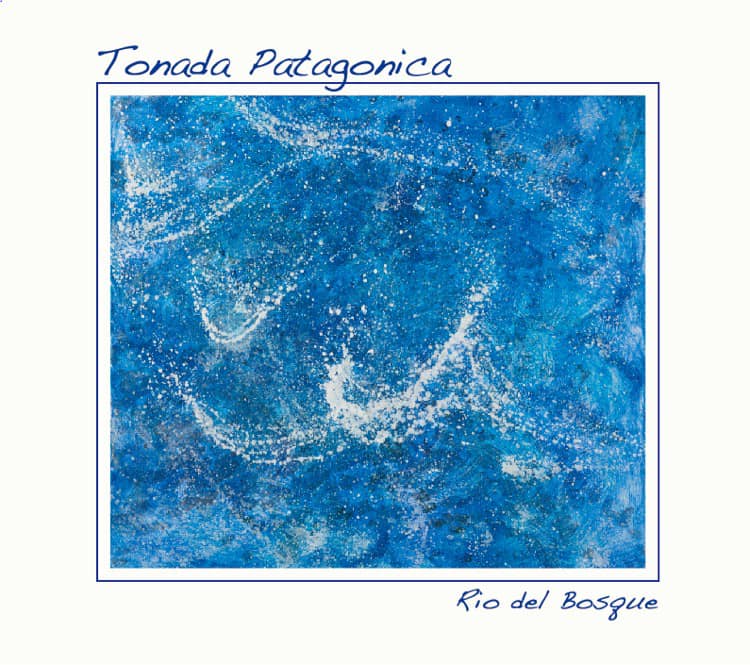
The region of Patagonia is shared by both Chile and Argentina – divided by the long Andes mountain range, which snakes its way down the length of the South American continent. The Andes creates contrasting climates, from deserts and steppes on the Argentina side, to fjords and rainforests on the Chilean side. Patagonian music is evocative of these dramatic and powerful landscapes. Tonada Patagonica is the first recording by the Japanese guitar duo Rio de Bosque, which reflects their close connections with both this country’s music and its musicians; it includes a new work, Cinco Minutos para Retornar, written for them by the Chilean composer and guitarist Javier Contreras. Alongside further compositions by Javier Contreras and by Hugo Muñoz, Hideo Morii and Haruka Shimizu have been inspired to compose their Tonada Inspiradora and Reflejo de Agua, which are also recorded here.
The practice of collecting traditional folk music has a long history throughout the world, with figures such a Bela Bartók (1881–1945) in Hungary, Felipe Pedrell in Spain (1841–1922) and Cecil Sharp (1859–1924) in Britain. However, rarely has this been undertaken by women, except in Chile. At the start of the twentieth century, two women – Margot Loyola Palacios (1918–2015) and Violeta Parra (1917–1967) – dedicated their lives to performing and preserving the traditional music of Chile. After her formal studies at the music conservatory of the University of Chile, Margot Loyola felt drawn to the land, and more drawn to the tonada and the cueca, than the music of Schumann and Bach. Violeta Parra had been composing from a young age but had had no formal music training. When Loyola and Parra first met, in the 1950s, Violeta Parra was singing one of her own tonadas and Loyola immediately recognized both the freshness of Parra’s composition and its strong connection with the Chilean folk tradition. They became friends and Loyola immediately set to work transcribing Parra’s compositions; and together they took them to be legally registered under her name. Their work as ‘folkloristas’ did much to promote the rural singers and poets of Chile.
During the turbulent political times of the 1960s and 1970s, Violeta Parra and another singer-songwriter (cantautor) Victor Jara (1932–1973), as well as ensembles such as Inti-Illimani and Quilapayún, expressed the struggles of their people to the world through music. Their compositions were built on the traditional folk music of Chile, the tonada and cueca – the national dance of Chile – and other folk forms such as the sirilla, which Violeta Parra used for her famous song Gracias a la vida. From this, La Nueva Canción Chilena – the New Chilean Song movement – developed. Their work has been immortalized by performers such as Joan Báez, Mercedes Sosa, Bob Dylan and Bruce Springsteen outside of Chile, and within Chile, their legacy lives on in the work of young Chilean composers and performers today, some of whose music appears on this recording. Javier Contreras explains the influences of folk music in his own compositions: ‘I have only taken the rhythmic patterns and general notions to compose some pieces from the perspective of a classical music composer, but always with free structures created by myself.’
1–5 Cinco Minutos para Retornar by Javier Contreras – 1. Tonada; 2. Espressivo; 3. Sirilla; 4. Milongueado; 5. Retorno. Javier Contreras: ‘I have written Cinco Minutos para Retornar for the excellent duo of Hideo Morii and Haruka Shimizu, who are versatile performers, who are very effective and skillful in playing music from Latin America. They have managed to perfectly decipher the characteristic rhythmic complexities of the music of this distant continent. I have wanted to take advantage of this great virtue of the duo of Hideo and Haruka to write a work that covers various complex rhythms of the continent, such as the tonada, the sirilla and the milonga. The work begins with a theme based on the tonada, and after a tour of some other Latin American rhythms, it returns to the tonada theme in the last movement – all this in “five minutes” (Cinco Minutos) as the title of the work explains. The music of this rhythmic and colorful continent will resonate in the hands of Hideo and Haruka.’
6. Reflejo de Agua by Haruka Shimizu – As Chile is a long, narrow country running down one side of the South American continent, the sea is never far away. Haruka Shimizu’s composition, Reflejo de Agua (The Reflection of Water), ‘is written in the style of a Chilean cueca. With this dance form, I tried to capture the light being reflected on the surface of sea in the region of Patagonia/Magallanes.’
7. Canción para una noche del sur by Javier Contreras – Canción para una noche del sur (Song for a Southern Night) is one of Javier Contreras’s early pieces. He played it on his first solo recording El Mirador de los Soñadores (The View of Dreamers) in 2006. Hideo Morii has arranged this solo guitar piece for a unique duo of guitar with Array mbira – a bell-like instrument, designed as a much more sophisticated form of a thumb piano – and the resonances of the two instruments complement and enhance one another. The guitar part is played by Haruka Shimizu and the Array mbira is played by Sayaka Shimizu.
8. Díptico Austral I and 9. Díptico Austral II by Hugo Muñoz – The spirit of Díptico Austral I and II for two guitars has a strong connection with the particular atmosphere of Punta Arenas, the capital city of the Magallanes and Antarctica Chilena region. For many, Punta Arenas is their final port of call before they make the treacherous journey across Drake Passage to the Antarctic. Hugo Muñoz explains the background to his Díptico Austral: ‘The first edition of the Guitarras de la Patagonia festival produced a space to write, interpret and record. Inspired by this meeting with my friend and teacher Javier Contreras Galindo in our native Punta Arenas, I wrote this duet as a dedication. In the first part, I have tried to express the nostalgic stillness of the southern landscape, evoking its aromas and colors as a reflection in the use of harmony. In the second part, I resort to the cultural heritage of Chiloé Island, evoking very personally, the rhythmic pattern of La Pericona, a traditional dance of the island rooted in Patagonia.’
10–12 Contracueca 1–3 by Javier Contreras – Although they are based on Chilean cueca, these Contracueca are intended to explore sound beyond the usual cueca. Hence, the meaning of the title is Contra-cueca (Anti-cueca). These three movements were originally written for guitar and piano; they were rearranged for guitar duo by the composer in 2022. These themes were also used in his Suite popular Chilena for guitar and orchestra.
The concept of the anticueca links back to Violeta Parra. She was a tireless researcher of Chilean folk music and travelled throughout the countryside collecting traditional music. Through her research, she found that there were four types of cueca in Chile: cueca corto; the cueca valseada; the cueca larga voluntaria; and the cueca larga obligatoria also known as the cueca del balance. Having defined the traditional cuecas, she was inspired to compose her five Anticuecas for solo guitar, which move beyond their folk forms, incorporating contemporary harmonic ideas of the mid-twentieth century.
13. Andenes from Díptico Latinoamericano by Javier Contreras – Javier Contreras plays in a cello and guitar duo, Dúo Torres-Contreras, with his wife Lucía Torres, to whom this work is dedicated. ‘The premise for this work is very simple: it is a poem about waiting to travel which, in different senses, everyone does, set in the ambiance of trains and their platforms (andenes),’ says Javier Contreras. Andenes is the first movement of his two-movement Díptico Latinoamericano for cello and guitar. It is a slow and melancholic introduction to the contrastingly vivacious Toccata, second movement. Díptico Latinoamericano has been performed and recorded regularly throughout the world over the past ten years. Here, the cello is played by Asaka Igarashi and the guitar by Hideo Morii.
14. Tonada Inspiradora by Hideo Morii – Hideo Morii composed this piece based on the style of a Chilean tonada, which in Chile is in a 6/8 rhythm. With Tonada Inspiradora, Hideo Morii pays homage not only to the composers of Chile but also to the tonada form itself, which has inspired many composers such as Javier Contreras and the Chilean singer-songwriters Violetta Parra and Victor Jara before them.
Biographies
Born in Chilean Patagonia, the composer and guitarist Javier Contreras has a prolific output of works written for the guitar and the guitar in ensemble, with a distinctive voice of his own which often reflects the beauty of the natural world. The sonorities in his music are often assisted by his creative use of scordaturas on the guitar, which expand the resonances and add to the expressiveness of his music. Initially taught by his father, Javier Contreras’ music was introduced to international audiences by his first classical guitar teacher, the celebrated Chilean guitarist, José Antonio Escobar. Contreras and Escobar have made a number of recordings together, however, this recording by the guitar duo Rio del Bosque features music written especially for the duo by Javier Contreras.
Hugo Muñoz is a guitarist, composer and arranger, who performs in a guitar duo with Javier Contreras. Both are from Punta Arenas, the southernmost city in Chile and of the continent itself. It was at the first edition of the festival Guitarras de la Patagonia in Punta Arenas, in 2021, where they had the opportunity to compose, perform and record together. They have made two recordings of their repertoire, Parajes (Pairs) volumes I and II, which includes their own compositions as well as works by the pianist and composer Karina Contreras – the sister of Javier Contreras. Hugo Muñoz performs in various chamber ensembles including Viola & Viola Dúo (guitar and viola), Ensamble Nómade de Guitarras and the Hugo Muñoz Quinteto (clarinet, guitar, viola, double bass and percussion).
Hideo Morii and Haruka Shimizu chose the name Rio del Bosque for their guitar duo because the core of their repertoire is drawn from the folk music of South America. Rio del bosque (Forest River) is a river of significance in the fantasy novels of J.R.R. Tolkien, particularly in The Hobbit, but for Hideo Morii and Haruka Shimizu it has further symbolic meaning in their choice of name for their guitar duo. The Chinese character for ‘Morii’ (森井) means forest and water well; the Chinese character for ‘Shimizu’(清水)means clean water or clean stream. Thus, Rio del Bosque was the ideal name to reflect their strong personal attachment to the music they love to perform.
Both Hideo Morii and Haruka Shimizu took classes with maestro Juan Falú and he suggested they should play in duo together. Since then, Rio del Bosque have played at various Japanese folkloric festivals and also at the Cosquín Folk Festival, one of the most important folk festivals in Argentina and in Latin America. Their interest has led them to be among the first overseas artists to focus on Magallanes regional guitar music.
Haruka Shimizu has a deep love of Latin American music and has developed an intimate knowledge and understanding of South American music through studying with artists such as Juan Falú, Carlos Moscardini, Ernesto Mendez, and Quique Sinesi and later collaborating with leading performers, including Ricardo Moyano, Javier Contreras, Mirta Alvarez and Facundo Rodriguez. In 2018, Shimizu recorded music by Carlos Moscardini for his debut CD, which was highly praised by the composer.
PLEASE RESPECT COPYRIGHT
Copyright © 2026 Thérèse Wassily Saba


Dear Thérèse, would you please inform my young colleague that in the Musical Supplement of Die Gitarre some short pieces of Japanese composers were published in the 30ties. I have to find them again so that I can give more precise information.
Best wishes Andreas
Gesendet mit der Telekom Mail App
LikeLike