Hans Werner Henze in Interview with Timothy Walker
In this centenary year of the German composer Hans Werner Henze (1926–2012), it was exciting to be able to discover an unpublished interview of Henze by the guitarist Timothy Walker. The interview has now been published in the Neue Zeitschrift für Musik – the journal established by Robert Schumann in 1834, which is now published four times a year by Schott Music.
Below, I include my introduction to the interview, which gives some background to the interview, as well as background to Timothy Walker and his work. The introduction and interview have been published in German: Timothy Walker im Gespräch mit Hans Werner Henze über dessen Kompositionen für Gitarre
An Unpublished Interview of Hans Werner Henze by Timothy Walker
Introduction by Thérèse Wassily Saba
For classical guitarists, the music of composer Hans Werner Henze has been an invaluable part of their repertoire since 1958, when he wrote Kammermusik 1958 for tenor, guitar and eight solo instruments, and included a significant part for classical guitar, which was premièred by the tenor Peter Pears and classical guitarist Julian Bream, with the Orchestra of the Norddeutschen Rundfunk conducted by Hans Werner Henze on 26 November 1958. The date of this landmark composition is etched on our hearts, almost as a musical signpost, that is, twentieth-century music for guitar before Kammermusik 1958 and after Kammermusik 1958.
Henze continued to write substantial works including the guitar such as El Cimarrón (1969–1970) – premièred in Berlin with the Cuban classical guitarist, composer and conductor Leo Brouwer (b. 1939), and then the two sonatas for solo guitar, Royal Winter Music, Sonata no. 1 (1975–1976) and Royal Winter Music, Sonata no. 2 (1979), both dedicated to Julian Bream (1933–2020).
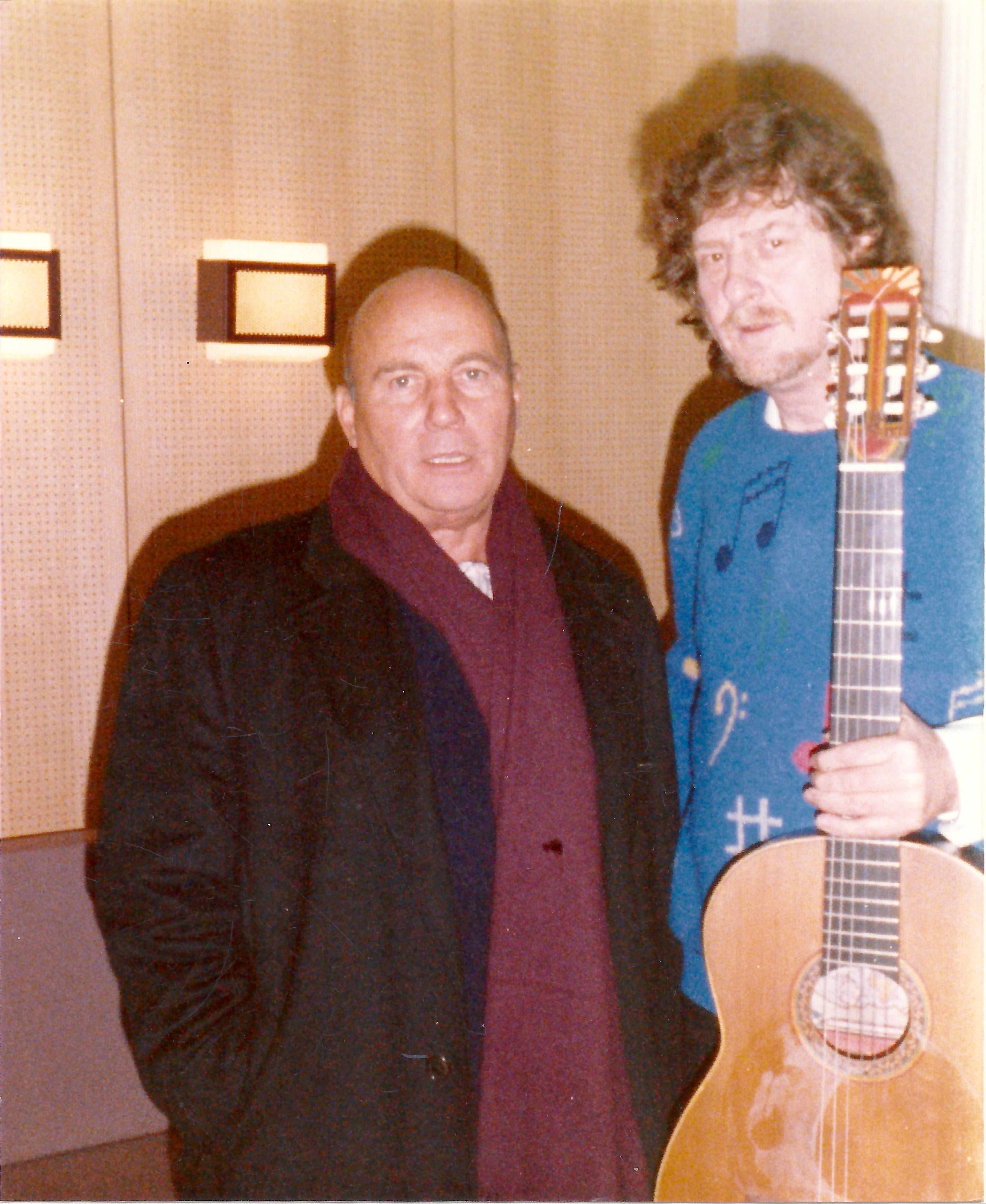
The classical guitarist Timothy Walker (1943–2021) was born in South Africa and later studied with Narciso Yepes in Spain before moving to London in the 1960s. In London, he was very involved in the contemporary music scene, performing in The Fires of London – the ensemble of composer Peter Maxwell Davies, performing in duo with John Williams as well as a soloist, and then becoming a professor at the Royal Academy of Music.
The cassette recording of the unpublished interview transcribed below was given to the guitarist Forbes Henderson by Timothy Walker, who hoped to have it published. With the death of Tim Walker in 2021 and with the forthcoming 100th anniversary of the birth of Hans Werner Henze in 2026, now seems the perfect time to publish this very relaxed interview, which must have been made on one of Henze’s many visits to London. It is undated but was possibly took place after a masterclass of Henze’s guitar works at the Royal Academy of Music, London. Henze was appointed International Chair for Composition at the Royal Academy of Music, London in 1987. In the interview, Henze expresses his views on the guitar as an instrument; he speaks of his first work for guitar, which was written for a radio play, and comments that it is unpublished.
More About Timothy Walker
Timothy Walker was born in South Africa in 1943. His parents were British and his father Oliver Walker (1906–1965), who was a well-known journalist, broadcaster and music critic, had emigrated to South Africa in 1937. Walker started to play the guitar at the age of 12, and when Narciso Yepes was on tour in South Africa, he invited Walker to study with him in Madrid. He also studied with Ida Presti and Alexandre Lagoya, and finally in London with John Williams, who recommended that he work with the Fires of London ensemble of Peter Maxwell-Davies. Maxwell-Davies wrote his first solo guitar piece called Lullaby for Ilian Rainbow for Timothy Walker’s son.
Walker’s career flourished and, as well as performing with the Fires of London, he played with London Sinfonietta, the London Symphony Orchestra, the BBC Symphony Orchestra, the Royal Philharmonic Orchestra, among others, and in ensemble, he worked with the Nash Ensemble, Melos Ensemble, Lindsey Quartet, among others. On 6 August 1977, he performed the première of Proença by John Buller for two soloists, mezzo-soprano Sarah Walker and electric guitar, with the BBC Symphony Orchestra, conducted by Mark Elder. This was a BBC Proms commission and in Proença, John Buller set Provençal poems by eleventh- and twelfth-century troubadours such as Jaufré Rudel, Pèire d’Alvernha, Bernard de Ventadorn, Marcabrun, Comtesse de Dia, Bertrand de Born and Pèire Cardenal. This substantial work was later recorded at the BBC’s Maida Vale Studios and released on NMC Records and was also selected by the 1978 International Rostrum of Composers.
Although Timothy Walker often worked with the mezzo-soprano Sarah Walker, there was no family connection there. Walker was often accompanying singers, including the tenors Robert Tear, Philip Langridge, Ian Partridge, James Griffett; baritones Michael Rippon and Christopher Keyte; mezzo-soprano Mary Thomas; and sopranos Jennifer Smith and Beverly Sills. He played under conductors such as Pierre Boulez, Colin Davies, Walter Suskind, Gunter Schuller and Hans Werner Henze.
His recordings include Timothy Walker Guitar Recital (L’oiseau-Lyre DSL03, 1974); Kammermusik / In Memoriam: Die Weisse Rose, composed and conducted by Hans Werner Henze, London Sinfonietta with Philip Langridge (tenor) and Timothy Walker (guitar) (L’oiseau-Lyre DSL05, 1975); Timothy Walker Plays Baroque Music (Saga 5426, 1976), released in Germany as: Timothy Walker Spielt Barocke Gitarrenmusik (Decca 6.42218, 1976); Guitar Encores by Timothy Walker (Hyperion A66027, 1977); and Classical Folk Guitar (Hyperion Records, 1981).
Timothy Walker began teaching at the Royal Academy of Music in 1987 and was a great inspiration to his students; he had his retirement celebration on Friday 13 May 2011, which included a performance of his Concerto for a Rainbow (1988). He died on 28 February 2021.
Copyright © 2026 Thérèse Wassily Saba


Thanks for this post on Henze, and Timothy Walker. I am looking forward to giving it full attention when my mind is less cluttered.. I only knew of Walker from the Evans’s book and the issue of CG you show above, which I once had- I remember, for some reason, the Raponi guitar. I have got Henze’s autobiography, but confess to only dipping into it here and there, primarily for Bream Content (hopeless Bream fanboy here). Thanks again-
Vince in Los Osos, California (who still wonders who took that superb photo of Bream on the cover of the 20th Century Guitar 1 JB Edition CD)
LikeLike
Dear Vince,
after putting together that blog post about Henze and Timothy Walker, even Forbes Henderson and I have been discussing how impressive his work was and that we hadn’t absorbed the full extent of it before! Of course, there is a lot more to say and, as a starting point, I must find my programme from Timothy Walker’s farewell recital at the Royal Academy of Music.
There are several versions of Julian Bream’s 20th Century Guitar recording, so I am unsure which photograph is on the version you have, otherwise I might have an answer.
Best wishes, Thérèse
LikeLike
Therese, thanks for your reply. Regarding the Bream photo, I’m talking about the one on the cover of the Julian Bream Edition multi-disc set put out by RCA, titled ‘Twentieth-Century Guitar i’, with Bream apparently in his music room holding what appears to be an old Hauser guitar, with a vase of fresh flowers on the table next to him. He has a certain look of determination on his face.. really my favorite Bream photo, I think. I have searched as much as I can to find out who the photographer was, but no luck so far.
Very Best Wishes to You-
Vince.
LikeLike